Adding a Machine
Everything so far has been passive. A synchronous machine brings two things that no previous tutorial needed: it has mechanical state, so it can swing, and it has to be told the operating point it starts from rather than deducing it.
The network is a machine feeding a strong grid through a line, with a fault applied at the machine terminal for 100 ms.
Machine parameters
A machine is specified by operational parameters rather than winding data:
gen = dpsimpy.dp.ph1.SynchronGenerator4OrderVBR("gen")
gen.set_operational_parameters_per_unit(
    nom_power=555e6, nom_voltage=24e3, nom_frequency=60.0, H=3.7,
    Ld=1.81, Lq=1.76, L0=0.15,
    Ld_t=0.3, Lq_t=0.65, Td0_t=8.0, Tq0_t=1.0,
)
The inductances are in per unit on the machine’s own base and the time constants in seconds. H is
the inertia constant, and it sets how fast the machine can accelerate: a low H swings further for
the same disturbance.
Each model order takes a different parameter set, and the difference is exactly the states it keeps.
The third order model omits Lq_t and Tq0_t because it has no q-axis rotor state at all. The
sixth order model adds the subtransient set, Ld_s, Lq_s, Td0_s, Tq0_s and Taa. Passing the
wrong set raises a TypeError listing the accepted signature. The equations are derived under
reduced order machine models.
The machine base and the network around it
The machine parameters are per unit on the machine’s own base, while the line is given in ohms, so the two only make sense together. The base impedance follows from the machine rating,
A line reactance of a few tenths of an ohm is therefore a few tenths per unit, which is an ordinary transmission connection. The same line specified as 20 mH would be 7.5 Ω, above 7 per unit, and no machine delivers rated power through that.
Watch out: an impossible operating point looks like instability
The consequence is worth knowing because it is not reported as an error. A machine asked to deliver more power than the network can carry simply accelerates: the rotor speed climbs monotonically and never returns, which looks like an unstable model rather than an impossible operating point.Initializing the machine
The network is initialized from a powerflow exactly as in the two-bus tutorial. The machine additionally needs its own operating point:
system_dp.init_with_powerflow(systemPF=system_pf, domain=dpsimpy.Domain.DP)

vterm = n1.initial_single_voltage()          # from the powerflow, magnitude and angle
gen.set_initial_values(
    init_complex_electrical_power=complex(300e6, 0),
    init_mechanical_power=300e6,
    init_complex_terminal_voltage=vterm,
)
Watch out: take the terminal voltage from the powerflow
Take the terminal voltage from the node rather than writing it out. It is tempting to passcomplex(24e3, 0) since that is the scheduled magnitude, but the generator bus is a PV bus and its
voltage leads the slack: here by 0.158 rad, about 9°. Supplying angle zero gives the machine a
rotor position inconsistent with the network it is connected to, and it starts by swinging into
agreement.The difference is measurable. With the angle assumed zero, the rotor speed oscillates by ±0.33% for the first half second, and a fault applied at 0.5 s lands on top of a transient that has nothing to do with it. Taking the voltage from the node, the pre-fault speed is flat to 5 × 10⁻⁶ pu and the only thing in the result is the fault.
That the mechanical power equals the scheduled electrical power is the other half of the same condition: if they disagree, the machine accelerates or decelerates from the first step.
What the model order changes
The same fault, applied to the same machine at the same instant, with three model orders:
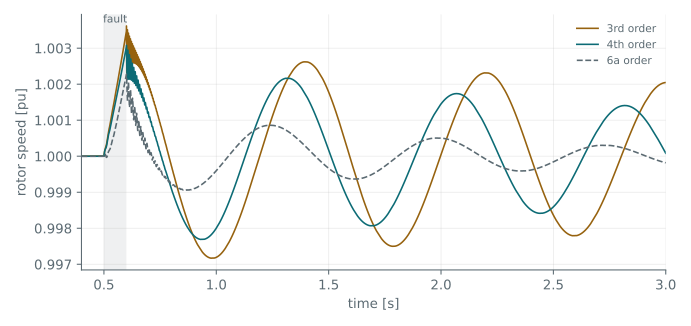
| Model order | Peak speed | States |
|---|---|---|
| 3rd | 1.00362 pu | field winding only |
| 4th | 1.00308 pu | field and one q-axis damper |
| 6a | 1.00228 pu | transient and subtransient, both axes |
All three peak at the clearing instant and all three recover, but the third order model swings noticeably further. That is not numerical: omitting the q-axis rotor removes damping that is physically present, so the third order machine is optimistic about how far it swings and pessimistic about how well it settles.
The practical reading is that model order is a statement about which phenomena you intend to capture. For a first-swing stability question the fourth order model is the usual choice. The subtransient orders matter when the first cycles after the fault are the subject rather than the envelope of the swing.
The script
The complete script for this page is 06_a_machine.py under examples/Python/Tutorials. The numbers quoted above are the numbers it prints, so if the two ever disagree the page is the one that is wrong.
Next
The machine is a source of energy with its own dynamics. Next is a converter, where the dynamics are in the control rather than in a rotor.